
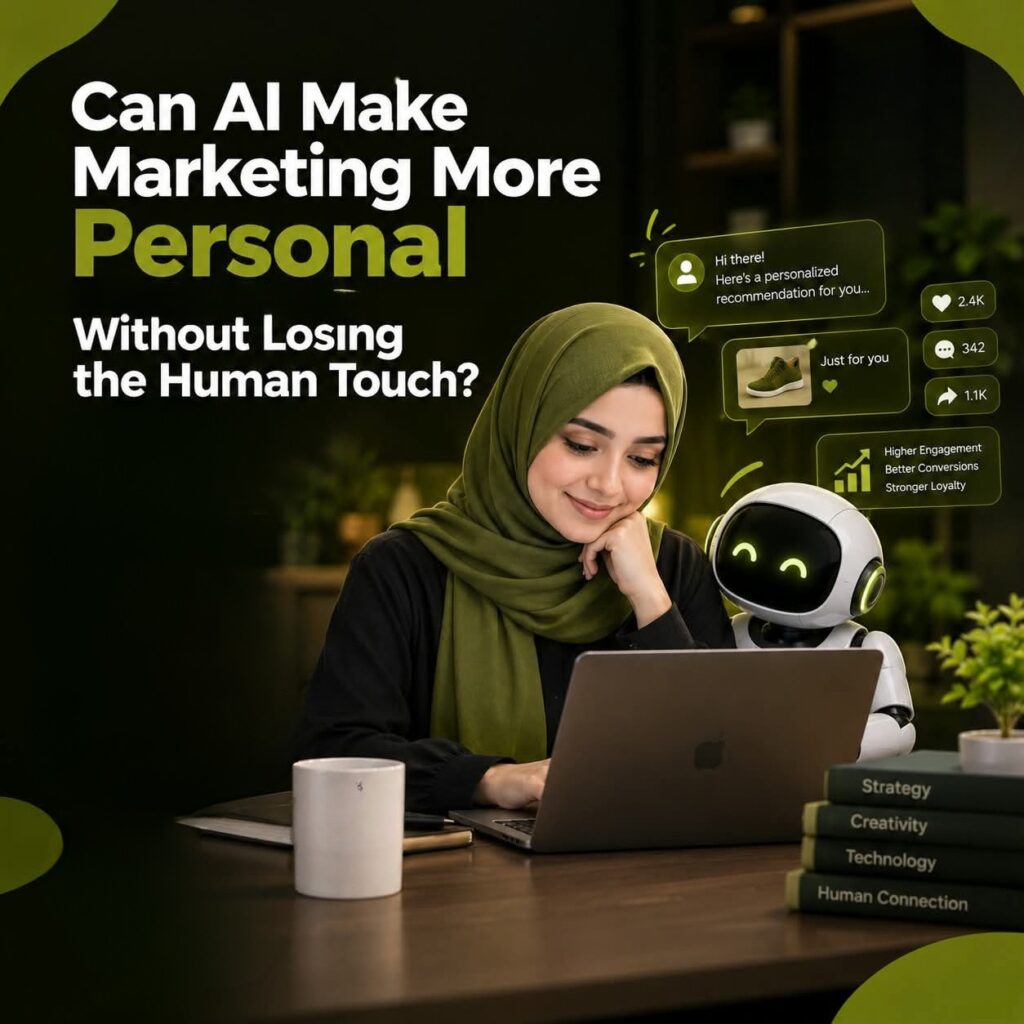
Can AI Make Marketing More Personal Without Losing the Human Touch?
Think about the last message from a brand that made you smile. Maybe it was a handwritten-style thank-you note tucked inside a parcel, or a reply from a support person who remembered your earlier problem. Now think about the last message that made you roll your eyes: a cheerful email greeting you by name, then pushing something you had no interest in.
Both were “personalized.” Only one felt human.
That gap is the central question for businesses in 2026. AI can now tailor messages, offers, and timing for thousands of people at once. But personal and human are not the same thing, and new-gen brands that confuse the two risk becoming efficient and forgettable.
So, can AI make marketing more personal without losing the human touch? Yes, but only if people stay in charge of the parts that matter. This article explains where AI genuinely helps, where it falls short, and why the best digital marketing strategist is the person who knows exactly where to draw that line.
Personal vs. Human: A Useful Distinction
Personalization is about relevance. It answers the question, “What does this customer likely want right now?” AI is excellent at this. It spots patterns in browsing, buying, and engagement that no team could track manually.
Human touch is about feeling. It answers a different question: “Does this customer feel cared for?” That comes from empathy, honesty, humor, and the willingness to go slightly beyond what is expected.
A message can be perfectly relevant and still feel cold. Another can be slightly imperfect and feel warm. The goal is to combine both, using AI for relevance and people for warmth.
What AI Does Well
Let’s give the technology its due. For a small team, AI offers real advantages.
It handles scale. Sorting thousands of customers into meaningful groups by behavior, interest, and buying stage used to take weeks. Now it takes minutes.
It finds timing. Predictive tools can suggest when a customer is likely to reorder or lose interest, so you can reach out at the right moment instead of guessing.
It speeds up variations. One campaign idea can be adapted for different audiences and languages. For a business in India, producing a message in English, Hindi, and Malayalam no longer needs three separate production efforts.
It removes repetitive work. Reporting, scheduling, resizing creatives, and answering basic questions can be automated, which frees your team to spend energy where it counts.
All of this is valuable. But notice that every item above is about efficiency. None of it is about emotion.
Where AI Falls Short
It doesn’t truly understand feelings. AI can detect that a customer wrote an angry message, but it can’t genuinely sympathize. A scripted apology often makes things worse.
It lacks lived experience. A founder who says, “we nearly shut down in our second year, and here’s what we learned,” creates a bond that a generated story cannot.
It tends toward sameness. When many brands use similar tools with similar prompts, their content starts to sound alike. Customers sense this even if they can’t explain it.
It can overstep. Automated systems don’t naturally know where the line sits between helpful and intrusive. That judgment belongs to people.
Seven Ways to Keep the Human Touch
1. Let AI draft, let people
Use AI to produce a first version of an email or caption, then have a real person edit it. Add a personal line, adjust the tone, remove anything that sounds stiff. The edit is where the brand’s personality lives.
2. Put real faces and voices forward
Show your founder, your team, and your customers. A short video from the owner explaining a new product does more for trust than a polished automated sequence. Sign emails with a real name and make replies actually reach a real inbox.
3. Personalize around helpfulness, not surveillance
Use data customers would expect you to have, such as past purchases or stated preferences. Avoid referencing behavior that might make people feel watched. If a message would make the customer ask, “How do they know that?”, rethink it.
4. Keep humans available at key moments
Automation is fine for order tracking and simple questions. For complaints, high-value purchases, or emotional situations, route customers to a person quickly. Nothing builds loyalty like being rescued by someone who clearly cares.
5. Be honest about using AI
If a chatbot is answering, say so. If content is AI-assisted, there’s no need to hide it. Customers tend to forgive automation far more readily than they forgive being misled.
6. Tell real stories
Share customer successes, behind-the-scenes struggles, and lessons from mistakes. Specific, true stories are the one asset that AI cannot manufacture authentically, and they’re what people remember.
7. Listen, then adjust
Read replies, reviews, and comments yourself. They reveal how your campaigns actually feel to the people receiving them, and they catch problems that dashboards miss.
A Practical Illustration
Picture a small organic snack brand. Using AI, the owner groups customers into health-focused buyers, busy parents, and gift shoppers, and tailors each email accordingly. That’s the personal part.
Then the owner adds the human part. Each Monday, she records a thirty-second voice note about something real, perhaps a farmer she met or a recipe that failed. She lets customers reply directly to her. When someone complains about a delayed order, she personally writes back with an apology and a small gesture of goodwill.
The AI saves her hours every week. The human touches are what customers mention in their reviews.
Signs You're Losing the Human Touch
Watch for these warning signals:
- Customers reply “unsubscribe” or “stop sending these” more often
- Your messages could be swapped between brands without anyone noticing
- Support replies feel scripted and customers repeat the same question
- Reviews describe your brand as “impersonal” or “automated”
- Your team no longer reads customer feedback because the system handles it
If you notice two or more, slow down. Add more human review and bring real voices back into your campaigns.
How to Measure Both Sides
Track efficiency and feeling together. For efficiency, look at conversion rates, repeat purchases, and cost per customer. For feeling, watch reply rates, review sentiment, referrals, and unsolicited compliments. A campaign that converts well but generates irritation is borrowing against future trust.
Simple questions help too. Add a line at the end of a survey: “Did this message feel helpful?” The answers can be surprisingly honest.
Why Strategy Is the Missing Piece
Tools can optimize. They cannot decide what is worth optimizing for. Someone has to determine how personal is too personal, which moments deserve a human reply, and what the brand’s voice should be when no template applies.
This is where the best digital marketing strategist earns their value. They begin with your brand’s character and your customers’ expectations, then decide where automation helps and where it would harm. They set review processes so AI output never goes out untouched, and they measure success in loyalty and trust, not just clicks.
When hiring a strategist or agency, ask:
- Where do you use AI in your process, and where do you deliberately avoid it?
- How do you keep our brand voice consistent across automated content?
- How do you measure customer trust, not just conversions?
- Can you share examples from businesses at a similar stage to ours?
Thoughtful answers show real experience. Promises of “fully automated growth” should make you cautious.
Final Thoughts
AI is not the enemy of the human touch. Used carelessly, it can flatten a brand into something generic. Used thoughtfully, it frees people from repetitive work so they can spend more time on what machines cannot do: listening, empathizing, and telling the truth in a memorable way.
For new-gen businesses, this is an opportunity. While larger competitors automate everything and sound the same, you can use the same tools to move faster and still sound like a real person who cares.
If you want marketing that is both smart and sincere, work with the best digital marketing strategist you can find, someone who uses technology to amplify your humanity instead of replacing it.